There is no single “best” treatment for nasolabial folds because there is no single cause of them. The appropriate approach depends on whether the appearance is primarily related to superficial skin creasing, facial movement, changes in underlying bone, mid-face changes, nasolabial fat, or a combination of factors.
A nasolabial fold may be a superficial crease in the skin caused largely by facial movement, a shadow related to changes in the bone around the base of the nose, or a fold created by changes in the mid face and nasolabial fat. Often, more than one of these factors is present at the same time.
This is why I don’t believe the visible line should automatically be treated simply because it is there.
The first step is understanding why that particular nasolabial fold is present, and whether treatment is appropriate at all.
What are nasolabial folds?
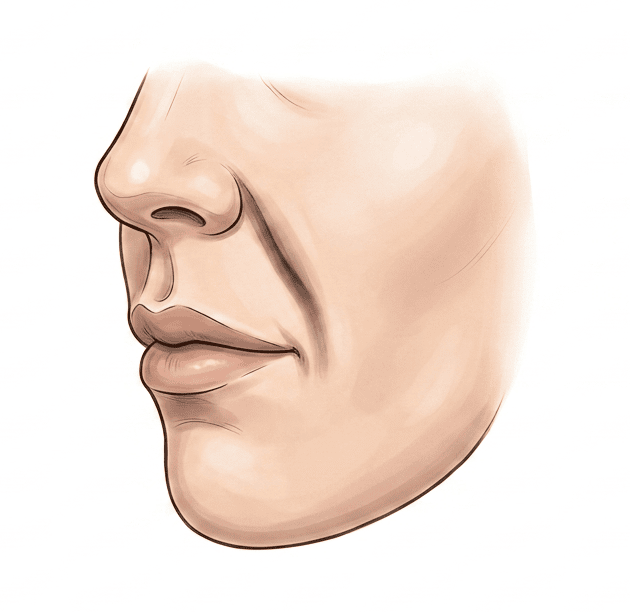
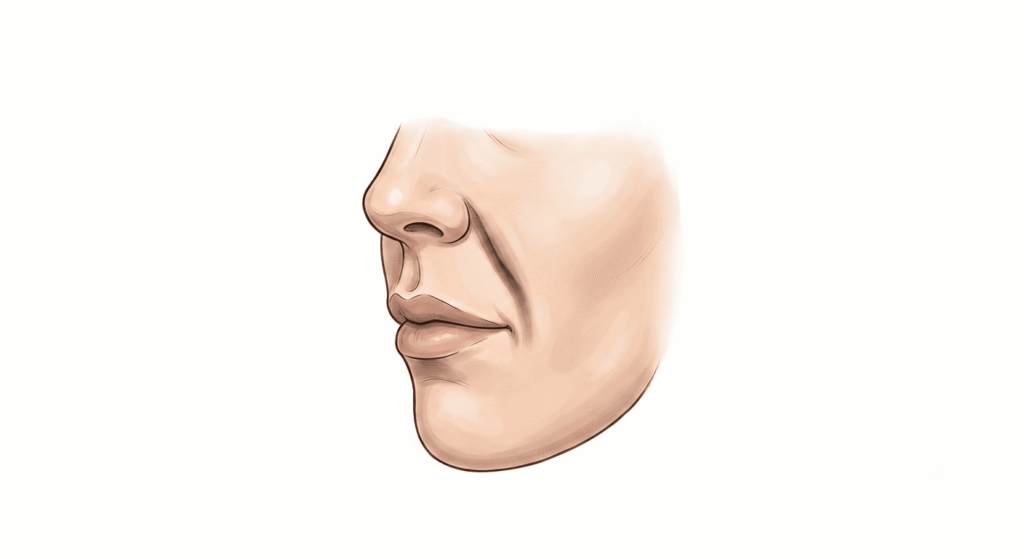
Nasolabial folds are the natural lines that run from the sides of the nose towards the corners of the mouth.
They are a normal part of facial anatomy and facial expression. They become more visible when we smile, laugh and talk, because the skin and underlying tissues naturally move and fold.
In fact, nasolabial folds aren’t something that only appear with ageing. Even babies have them.
What changes with age is the appearance and prominence of these folds.
This distinction is important because the goal shouldn’t necessarily be to completely eliminate a nasolabial fold. In many people, trying to make the area completely smooth can produce a result that looks less natural, particularly when the person smiles or talks.
For most patients, the more appropriate goal is to soften the appearance of the fold while maintaining natural facial movement and expression.
Why do nasolabial folds become more prominent with age?
There isn’t one anatomical change responsible for every nasolabial fold.
As the face ages, changes can occur in the skin, fat compartments and underlying bone. These changes can alter the support and contours of the mid face and make an existing nasolabial fold appear deeper or more noticeable.
Changes in the mid-face
The mid-face provides important structural support to the tissues above and around the nasolabial region.
With ageing, there can be changes in the volume and position of the facial fat compartments, as well as changes to the underlying facial bones.
When the mid face loses some of its structural support, the skin and soft tissues can appear to “sink” and descend.
This can make the area around the nasolabial fold appear more pronounced.
Volume loss assessments for the mid-face form part of the nasolabial fold consultation.
Changes in the nasolabial fat
An interesting aspect of facial ageing is that not all facial fat simply depletes.
Some research has demonstrated that the nasolabial fat compartment can actually increase in size with age, while also changing position.
This is important because it challenges the common idea that every facial fold is simply caused by a lack of volume.
The appearance of the nasolabial fold can be influenced by the relationship between neighbouring structures. If the mid-cheek loses support and becomes more recessed, the nasolabial fat can appear increasingly prominent next to it.
The result can be a more noticeable fold or transition between the cheek and upper lip.
This is one reason why treating only the visible line doesn’t always address the underlying cause.
How I assess the nasolabial folds
When assessing a patient, I don’t simply look at how deep the fold appears.
I look at what the fold actually looks like and where the prominence is coming from.
There are several patterns I commonly consider.
1. A superficial crease in the skin
Some people have a relatively fine crease that is etched into the skin.
This can be particularly noticeable when they smile or animate.
In these cases, facial movement and muscle activity may be contributing significantly to the appearance of the crease.
This is quite different from a deep shadow created by a loss of underlying structural support.
Approaches to support the skin quality and assist in collagen production for superficial creases may be discussed, including wrinkle-reduction and Rejuran options.
2. Shadowing beside the nose
Another presentation is a deeper-looking shadow or groove next to the nostril.
In some patients, this appearance can be associated with changes in the underlying bone around the nasal opening, including resorption around the piriform aperture.
This can create a shadow that makes the nasolabial region appear deeper even when the skin itself isn’t necessarily the main problem.
Shadowing next to the nose is the only ‘volume loss‘ that occurs in the nasolabial fold.
Aesthetic ultrasound may be used in volume loss consultations to identify individual anatomy of the nasolabial fold.
3. Folding of the nasolabial skin
Some patients have more prominent nasolabial tissue and a visible fold where the skin sits over this area.
Changes in the nasolabial fat, combined with loss or repositioning of mid-face fat and changes in underlying bone support, can contribute to this appearance.
These different presentations can look superficially similar in a photograph, but they don’t necessarily have the same underlying cause.
And sometimes, a patient has two or more contributing factors at the same time.
Why I don’t automatically treat the nasolabial fold itself
One of the most common misconceptions I see is:
“I can see a line, so the line must be where the problem is.”
Facial ageing doesn’t work quite that simply.
A visible line can be the result of changes occurring somewhere else.
For example, imagine a patient who has lost support through the mid-face. Changes in the facial fat compartments and underlying bone can alter the contour of the cheek. The resulting change in support can make the nasolabial region appear more prominent.
In that situation, simply focusing on the line may not be the most appropriate way to approach the concern.
This is why I assess the whole mid face and surrounding anatomy, rather than looking at the nasolabial fold in isolation.
Your age isn’t necessarily an indication of how deep your folds should be
Age is certainly relevant to facial ageing, but chronological age doesn’t tell me everything I need to know.
I’ve seen patients in their early thirties with quite prominent nasolabial folds, while some patients around 50 have relatively subtle folds.
Genetics, facial anatomy, bone structure, fat distribution, facial movement and changes in weight can all influence how prominent a person’s nasolabial folds appear.
For a younger patient who appears to have experienced a noticeable loss of facial volume, weight loss may also be a contributing factor.
A significant change in body weight can alter facial volume and therefore change the appearance of the nasolabial region, even when someone isn’t experiencing the same age-related changes as an older patient.
I also consider dental position and bite position in some patients, as they may be relevant to the facial structure and appearance.
Static and dynamic assessment are both important
A person’s face isn’t static.
We smile, laugh, talk and express emotion throughout the day.
For this reason, I don’t assess nasolabial folds only when a patient is sitting completely still.
I look at the face at rest and during movement.
A fold that appears noticeable when someone is smiling may be completely normal facial movement. Trying to eliminate that movement-related fold entirely could create an unusual or unnatural appearance when the person is animated.
This is particularly important when patients are comparing themselves with photographs they have seen online.
Why social media can create unrealistic expectations
One of the problems with treating facial folds today is that people are constantly exposed to images of faces that don’t necessarily represent real-life anatomy.
Filters, retouching and carefully selected photographs can make it appear as though completely smooth skin is the normal expectation.
It isn’t.
A real face has folds, creases, shadows and movement.
The nasolabial fold naturally becomes more pronounced when we smile, laugh and talk. Expecting it to remain completely flat throughout all facial expressions isn’t necessarily a realistic or desirable outcome.
I often tell patients that the goal is to soften, not eliminate.
Why treating a nasolabial fold may not be appropriate
Some people come to a consultation concerned about what I would consider a normal amount of fine creasing or shadowing.
In these situations, treatment isn’t necessarily the answer.
If I believe that attempting to completely remove a normal anatomical feature is likely to result in an unnatural appearance, I will explain that to the patient.
There are also situations where a patient’s expectations aren’t realistic enough for me to recommend treatment.
I would rather tell someone that I don’t think treatment is appropriate than perform a treatment simply because they have requested it.
In some circumstances, a patient may also be better suited to an alternative treatment approach or another practitioner, and I may recommend that they seek a different opinion.
Why over-treating the area can look unnatural
One of the potential problems with trying to completely flatten the nasolabial region is that the natural transition between the cheek and upper lip can be lost.
If the area becomes excessively full, the cheek can appear to blend into the upper lip region, producing what I sometimes describe to patients as a “chipmunk” appearance.
The face can look smoother while simultaneously looking less natural.
This is why I don’t believe that “more treatment” automatically means a better result.
Chasing perfection can sometimes take us further away from what looks natural.
So, what is the best treatment for nasolabial folds?
The answer is:
The best treatment is the treatment that addresses the underlying cause of the particular nasolabial fold, if treatment is appropriate at all.
For one person, facial movement and superficial skin creasing may be an important contributor.
While another persons nasolabial fold appearance may be influenced by structural changes around the piriform aperture.
And another person may have changes in the mid-face, including changes in cheek fat volume and position, nasolabial fat prominence and underlying bone support.
And for many people, there will be a combination of factors.
This means that there isn’t a universal treatment that can be labelled the “best treatment for nasolabial folds”.
It also means that treatment doesn’t necessarily need to be directed into the visible fold itself.
Why a consultation is important
A proper assessment allows me to determine what is contributing to the appearance of the nasolabial region, whether treatment is likely to produce a meaningful improvement, and whether the patient’s expectations are realistic.
I assess the fold at rest and during facial movement, consider the surrounding anatomy and look at how different areas of the face relate to one another.
I also consider factors such as age, genetics, facial structure, changes in weight, mid-face volume and, where relevant, dental position.
The treatment plan should come after this assessment, not before it.
This is particularly important when someone arrives at a consultation already convinced that they need a specific treatment because they have seen it recommended online.
The treatment that is appropriate for someone else’s nasolabial folds isn’t necessarily the treatment that is appropriate for yours.
The bottom line
Nasolabial folds are a normal part of facial anatomy.
They don’t need to be completely removed, and in many cases, attempting to do so can create an unnatural appearance.
The most important question isn’t simply:
“How do I get rid of my nasolabial folds?”
It is:
“Why are my nasolabial folds prominent?”
Once the underlying anatomy and contributing factors have been identified, it becomes possible to determine whether treatment is appropriate and, if so, what approach may be suitable.
For me, this is the most important part of treating any facial ageing concern:
Technique should follow diagnosis, not the other way around.
Frequently Asked Questions
There is no single best treatment for everyone. Nasolabial folds can have different causes, including superficial skin creasing, facial movement, changes in the bone around the piriform aperture, changes in the mid-face fat compartments and changes in the nasolabial fat. A consultation is important to identify the contributing factors before deciding whether treatment is appropriate.
Usually, the goal should be to soften rather than completely eliminate a nasolabial fold. Nasolabial folds are a normal part of facial anatomy and naturally become more prominent with smiling, talking and laughing. Completely flattening them can result in an unnatural appearance.
Age is only one factor. Genetics, facial anatomy, bone structure, fat distribution, facial movement and changes in body weight can all influence the appearance of nasolabial folds. Some younger people naturally have more prominent folds than others.
Facial ageing involves changes in both the volume and position of different fat pads. Some research has found that the nasolabial fat compartment can increase in size with age, while fat in the mid-face decreases in size with age. Changes in the mid-face can therefore make the nasolabial region appear more prominent without the problem simply being a lack of volume.
Not necessarily. The visible fold may be the result of changes in surrounding structures, such as the mid face or underlying bone, rather than being an isolated problem with the fold itself. This is why assessment of the whole area is important.
Facial movement can contribute significantly to the appearance of some nasolabial creases. Assessing the face both at rest and during movement helps determine how much of the appearance is related to normal facial animation.
No. Nasolabial folds are a normal and proportionate feature of the face, and treatment may not provide a worthwhile or natural-looking improvement. In some patients, the most appropriate recommendation is not to treat the area.