Nasolabial folds

Nasolabial folds are natural lines that extend from the sides of the nose to the corners of the mouth. They are sometimes referred to as smile lines due to their visibility during facial expression. These lines can become more noticeable over time due to a combination of structural, muscular, and age-related changes in the face.

A nasolabial fold consultation at MD Cosmetic Nurse focuses on assessing your individual anatomy, volume, symmetry, and proportion in relation to your overall facial structure for natural-looking outcomes. Aesthetic ultrasound may used to 'vascular map' and identify relevant arteries.

Book A Consultation
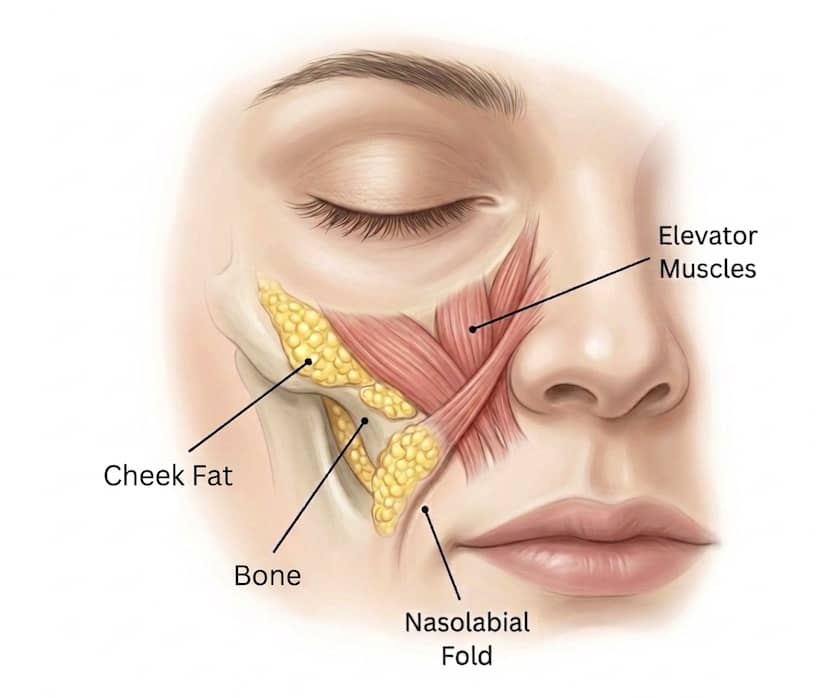
Anatomical diagram of the nasolabial fold showing skin layers, facial muscles, fat compartments, and cheek structure.

Anatomy of Nasolabial Folds

The nasolabial fold is formed by the interaction of multiple anatomical structures in the mid-face, including the skin, fat compartments, facial muscles, and underlying bone.

Facial fat in the cheek region provides structural support that may influence how the nasolabial fold appears. Over time, bone resorption causes loss of structural support for the overlying skin and fat, increasing the appearance of shadowing and hollowing.

Several muscles are involved in facial expression, particularly those that elevate the upper lip when smiling. Over time, the combined effects of facial movement and structural changes can influence the visibility of the nasolabial fold.
What contributes to nasolabial folds?

The appearance of nasolabial folds is influenced by multiple factors rather than a single cause. These may included changes in facial structure, repeated muscle movement, and shifts in skin support over time.


Structural Support and Volume Changes

The mid-face plays a key role in supporting the nasolabial fold. Over time, changes in fat compartments, connective tissue, and underlying bone structure can influence how this area appears.

These structural changes are often considered alongside broader facial structure and volume changes during a consultation.


Movement and facial expression

Facial expression such as smiling involve multiple muscles in the mid and lower face. Repeated movement over time can contribute to the visibility of nasolabial folds.

You can lean more about how smile movement contributes to lines in other areas such as around the sides of the eyes.


Relationship to the cheek area

The cheeks provide structural support to the mid-face. Changes in the cheek region over time can influence how the nasolabial folds appear, particularly in relation to facial contour and balance.


Other contributing factors

Additional factors such as genetics, lifestyle, and environmental exposure may also influence how prominent nasolabial folds appear over time.

Our facial aging page explains further causes of nasolabial folds.


How the nasolabial folds are assessed

A nasolabial fold consultation at MD Cosmetic Nurse focuses on assessing your individual anatomy, symmetry, definition, and proportion in relation to your overall facial structure. During some consultations, aesthetic ultrasound is used to 'vascular map' and identify relevant arteries. Rather than a standard approach, each consultation begins with a thorough facial assessment to understand your unique anatomy and what your nasolabial folds concerns are. Consultations may include consideration of skin quality, facial structure, and wrinkle formation, depending on individual concerns.

Common concerns discussed during a nasolabial fold consultation include:

• Loss of volume or definition over time
• Asymmetry between sides
• Hollowness causing shadowing
• Superficial wrinkles and fine lines
• Depth of the nasolabial folds
• Mid-face volume loss and support that may contribute to nasolabial folds
• Natural-looking enhancement that complements your features

Why choose MD Cosmetic Nurse for a nasolabial fold consultation?

Choosing the right practitioner for your aesthetic consultation is an important decision. All assessments at MD Cosmetic Nurse are tailored to each individual, and are consultation-led. This means your individual concerns, anatomy, and goals are discussed in detail before any treatment is considered. Michelle is centred on professionalism, ethical, evidence-based practice, and patient safety.

• Experienced registered nurse with over 12 years experience performing aesthetic procedures.
• Master of Nursing with a year-long capstone project on complications with aesthetic procedures.
• A natural-looking, balanced approach for subtle outcomes.
Aesthetic ultrasound use in select consultations to provide insight for your individual anatomy.
• Consultations are conducted in professional, medical clinical environments inside specialist plastic surgeon-owned clinics in Surry Hills and Mosman, as well as Penrith.

Book a consultation for a detailed facial assessment to determine suitability for your individual goals. Individual results vary from person-to-person and from treatment-to-treatment. A consultation is required and does not guarantee treatment.

Book A Consultation

Frequently Asked Questions

Nasolabial folds are natural lines that run from the sides of the nose to the corners of the mouth.

They may become more visible due to changes in facial structure, repeated muscle movement, and reduced stratal support in the mid-face and bone structures.

They are considered structural folds when there is hollowing. Fine lines in the skin can be influenced by ageing and facial movement such as smiling.

Yes, they are closely connected to the cheeks and mid-face, which help support overall facial structure.