What Causes Jowls? Understanding Why They Develop and Your Treatment Options
- Facial Ageing
- July 9, 2026


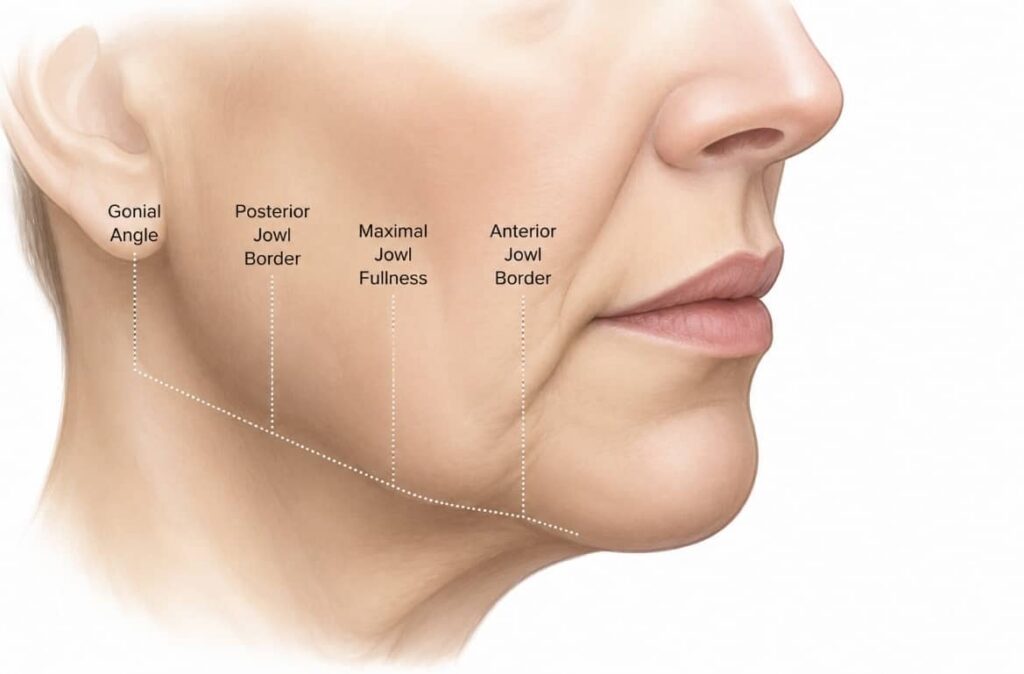
If you’re wondering what causes jowls, the answer is that they are usually caused by a combination of age-related changes rather than a single problem. As we age, jowl fat can enlarge and shift downwards, skin and connective tissues become less supportive, the jaw bone resorbs and tissue begins to collect behind retaining ligaments, creating the appearance of a jowl. While some non-surgical treatments may help the surrounding facial support or disguise early jowls in selected patients, there is currently no non-surgical treatment that removes jowls completely. The most appropriate approach depends on the cause, severity and your individual facial anatomy.
What are jowls?
Jowls are the areas of tissue that develop along the lower jawline, usually on either side of the chin. They often make the jawline appear less defined and are one of the most common concerns I see during facial ageing consultations.
Interestingly, when patients tell me they are worried about their jowls, they are usually pointing directly at the jowl itself, not necessarily the jawline or neck. Understanding exactly what someone is concerned about is an important part of assessing the underlying cause.
What actually causes jowls?
One of the biggest misconceptions is that jowls are simply caused by “loose skin.”
In reality, they usually develop because several changes occur together over many years.
Changes in facial fat
Facial fat doesn’t simply disappear with age.
Different fat compartments behave differently. In the lower face, fat can enlarge or change position over time. Combined with weakening support from the surrounding tissues, this can contribute to fullness along the jawline.
Skin and connective tissue changes
Our skin gradually loses collagen and elasticity with age.
The connective tissues that support the face also become less supportive over time. This allows tissues to descend more easily.
Retaining ligaments
One of the most important contributors is the retaining ligaments of the face.
As the surrounding tissues descend, they can collect or “pool” behind these ligaments. Rather than everything moving evenly downward, the ligaments hold certain areas in place while tissue gathers beside them, creating the characteristic appearance of a jowl.
This is one reason why jowls are rarely caused by a single factor. To learn more about jawline anatomy, visit our jawline page.
Why treating jowls can be challenging
Because jowls develop from several different anatomical changes, there is rarely one simple solution.
Many patients arrive believing there is a single treatment that will “remove” their jowls. Unfortunately, that’s not how facial ageing works.
The treatment options depend on:
- skin quality
- skin thickness
- facial bone support
- facial volume
- overall facial proportions
- severity of the jowl
- your goals and expectations
Every assessment is different.
Can volume replacement get rid of jowls?
This is probably the biggest misconception I see.
Many people believe adding volume treatments along the jawline will remove a jowl.
Sometimes, select patients with mild changes may see a disguised the transition between the jowl and surrounding tissues. During a consultation, I assess areas such as the pre-jowl and post-jowl regions to determine whether a small amount of support may improve the overall contour.
However, this does not remove the jowl itself.
If the jowl is already significant, adding increasing amounts of volume to disguise it can make the lower face appear wider or heavier.
In women especially, we generally aim to maintain a more balanced distribution of facial volume rather than creating excessive fullness in the lower face.
A common example I see in practice
One situation I occasionally see is patients who have previously had repeated lower-face volume treatments elsewhere because they were hoping to improve their jowls.
Although the jawline may appear fuller, the jowl itself often remains.
Instead of creating a more defined jawline, the additional volume can sometimes make the lower face look “heavier”, or more “masculine” with a wider, squarer jawline without addressing the underlying cause of the concern.
This is one reason why understanding why the jowl has developed is far more important than simply adding more volume.
Is referral for a consultation with a specialist plastic surgeon recommended?
Sometimes.
This can be a difficult conversation, but I believe it’s important to set realistic expectations.
If someone has significant skin laxity and heavier jowls, there is currently no non-surgical treatment that can remove the excess tissue.
Rather than recommending treatments that are unlikely to achieve the result someone is hoping for, I prefer to have an honest discussion about what can realistically be achieved.
For some patients who are open to it, a consultation with a plastic surgeon may be the most appropriate option to discuss surgical management.
Are there non-surgical options?
During a personalised consultation, we assess whether there are aspects of facial ageing that may be appropriate to address.
Depending on your individual assessment, recommendations may focus on improving skin quality and support with treatments such as Rejuran, or addressing surrounding facial changes that can influence the appearance of the lower face including wrinkle treatments.
However, it is important to understand that these approaches do not remove the jowl itself, and results vary depending on the underlying cause and severity.
The most appropriate recommendations can only be made after a comprehensive facial assessment.
How I assess patients concerned about jowls
Every consultation begins with understanding what concerns you most.
From there, I perform a comprehensive facial assessment rather than looking only at the jowl itself.
This includes assessing:
- facial bone support
- skin quality
- skin thickness
- skin laxity
- the midface and lateral face
- areas around the jowl, including the pre-jowl and post-jowl regions
- overall facial balance
When appropriate, I also use facial ultrasound before volume loss consultations as part of my commitment to patient safety. Ultrasound is used for vascular mapping prior to treatment rather than assessing the cause of jowls themselves.
My approach
One of the most important parts of my job is helping patients understand what is—and isn’t—realistically achievable.
Sometimes, the right recommendation is no treatment.
If I don’t believe a non-surgical approach is likely to achieve your goals, I’ll tell you. I would rather have an honest conversation than recommend treatments that are unlikely to provide the improvement you’re hoping for.
Frequently Asked Questions
Jowls develop due to a combination of age-related changes, including facial fat redistribution, skin and tissue laxity, and changes in facial support structures.
There is currently no non-surgical treatment that removes jowls completely. In some patients, certain approaches may improve surrounding facial support or soften the appearance of early jowls, but they cannot remove excess tissue or stop the ageing process.
Ageing is progressive. Changes in facial fat, skin, connective tissues and bone continue over time, which is why jowls often become more noticeable with age.
No. The most appropriate management depends on the cause and severity of the jowls and your treatment goals. In some cases, you may be referred to have a consultation with a specialist plastic surgeon to discuss your concerns.