What causes a short chin?
- Facial Ageing General
- September 30, 2026


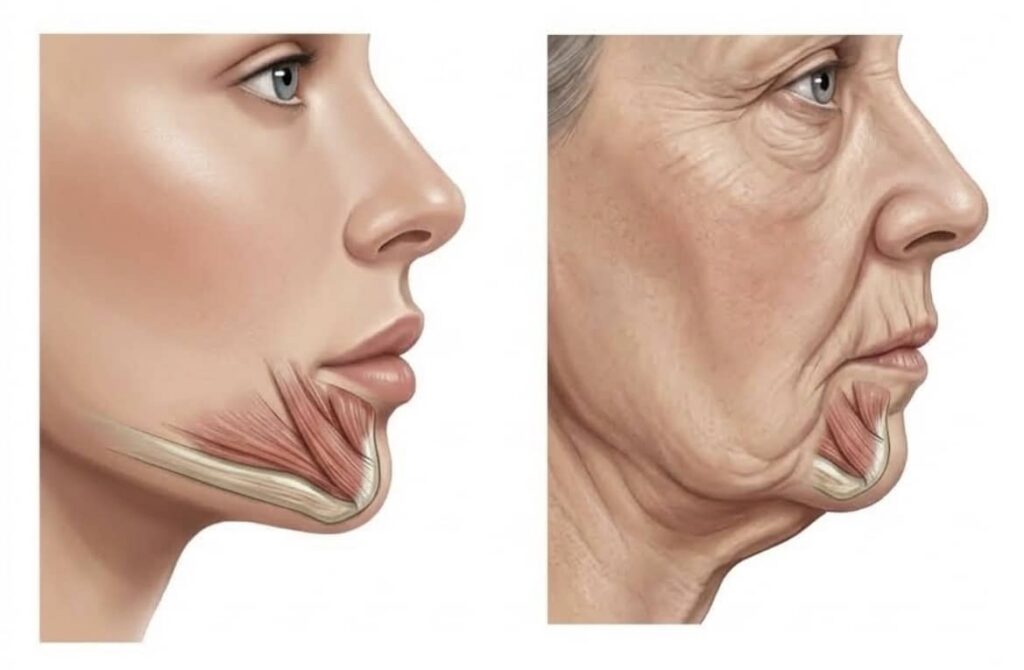
A short chin can be caused by several different anatomical factors, including the underlying bone and jaw position, vertical chin height, muscle activity, the position of the lips, and changes to the surrounding soft tissues with age. Sometimes, more than one factor is present at the same time.
Importantly, a chin that looks short or recessed does not necessarily mean the chin itself is the problem.
When I assess the lower face, I look at the chin in relation to the lips, nose, jawline and overall facial proportions rather than assessing the chin in isolation. This is important because the same appearance can have very different underlying causes.
Short chin vs recessed chin: what is the difference?
The terms “short” and “recessed” are sometimes used interchangeably, but they describe different aspects of the chin.
A short chin generally refers to reduced vertical height – how long the chin appears from the front.
A recessed or regressed chin refers more to its position from the side profile – how far back the chin sits in relation to the lips, nose and rest of the lower face.
A person can have one without the other.
For example, someone may have reasonable vertical chin height but relatively little forward projection. Another person may have a chin that is both vertically short and positioned further back. Some people naturally have a smaller chin that is completely proportionate to the rest of their face.
There is no single chin length or degree of projection that is ideal for everyone.
What causes a short chin?
1. Bone and jaw position
The shape and position of the lower jaw are major factors in the appearance of the chin.
The chin is part of the mandible, so its position is influenced by the underlying skeletal structure and the relationship between the upper and lower jaws.
Dental and skeletal relationships can also affect the appearance of the profile. Malocclusion, for example, can alter the position of the lower jaw and therefore the apparent projection of the chin.
This is something I see in consultations: a person may present because they are concerned that their chin looks short or recessed, but when I assess the facial proportions, the underlying issue may be related to the bite or jaw position.
In some cases, the appropriate next step is an assessment by a dentist or another appropriately qualified practitioner. If the underlying cause is skeletal or dental, it is important to understand and address that cause rather than simply focusing on the appearance of the chin.
2. Vertical chin height
A chin can appear short because there is less vertical height between the lower lip and the bottom of the chin.
This is different from forward projection.
It is possible to have a chin that projects reasonably well from the side but still appears relatively short from the front. Conversely, someone can have a reasonable vertical height but less forward projection.
This is one reason why I assess the face from more than one angle.
Looking only at a frontal photograph can miss an important part of the picture.
3. Mentalis muscle activity
The mentalis muscle is another factor that can influence the appearance of the chin.
The mentalis is involved in movements of the lower lip and chin. Some people recruit the mentalis to help bring their lips together, particularly when their lips do not naturally meet comfortably at rest.
When the muscle contracts strongly, it can alter the appearance of the chin from the side profile and may contribute to a more bunched or dimpled appearance.
One patient I assessed was concerned because her chin appeared both “short” and dimpled. During the consultation, I asked whether she felt she had to push her lower lip upwards to close her lips.
She said yes.
On assessment, it became apparent that she was using her mentalis muscle to help close her mouth because her lips did not meet without that muscular effort.
That observation was important.
If someone relies on a muscle to help achieve lip closure, that functional aspect needs to be considered as part of the assessment before developing any treatment plan. The goal should never be to look at an isolated aesthetic feature without considering how the muscles and surrounding structures function.
4. The position and fullness of the lips
The lips can also change how the chin appears from the side.
For example, when the lips project significantly forward relative to the rest of the facial profile, the chin can appear further back by comparison.
This does not necessarily mean that the chin has changed.
It can be a matter of proportion.
I have seen patients present with concerns about chin recession when, on assessment, the position of the chin itself was actually reasonably proportionate to the nose and the rest of the profile.
In one consultation, I assessed the patient’s profile using established facial reference concepts, including the Ricketts E-line and Steiner S-line. These are cephalometric reference lines used in orthodontic and facial analysis to help assess the relationship between the lips, nose and chin.
These measurements are reference points rather than absolute rules. Facial proportions vary between individuals, and a person’s natural anatomy does not need to conform to a single numerical standard.
In this particular case, the chin itself appeared proportionate to the nose. The apparent imbalance was largely related to the prominence of the lips.
No treatment directed at the chin was recommended.
This is an important distinction: sometimes the most appropriate clinical decision is to recognise that the feature a person is concerned about is not actually the source of the imbalance.
5. Age-related changes around the chin
The appearance of the chin can also change as the face ages.
This is rarely due to one single process.
Age-related changes can include changes to the underlying bone, alterations in muscle activity, skin laxity, soft-tissue descent and changes in the distribution and prominence of fat around the lower face.
The jowl area is particularly relevant.
As the tissues of the lower face change with age, increased fullness and descent around the jawline can make the central chin appear smaller by comparison.
In other words, the chin may not actually have become substantially smaller – the surrounding structures have changed.
I have seen this in mature patients who feel that their chin has “disappeared” or become shorter with age. On assessment, the underlying chin projection can actually be quite good.
In one such consultation, the surrounding lower-face fullness, particularly around the jowl region, was contributing to the appearance of a smaller chin.
When the overlying skin was gently repositioned during assessment, more of the underlying mandibular contour and chin projection became visible.
This demonstrates why the chin should not be assessed independently from the jawline and surrounding soft tissues.
Can more than one factor cause a short chin?
These factors do not always occur separately.
A person may have naturally reduced chin projection combined with a shorter vertical chin. Someone else may have a skeletal difference together with increased mentalis activity. Another person may have a naturally proportionate chin but develop changes around the jawline with age that make the chin appear less prominent.
It can therefore be misleading to look at a patient and conclude that someone simply has a “small chin.”
The appearance is the end result of several anatomical relationships.
How I assess chin proportions
When assessing the lower face, I don’t look at the chin as an isolated feature.
I consider:
- Vertical chin height — how long the chin appears from the front
- Forward projection — how far the chin sits forward in profile
- The underlying jaw and dental relationship
- Mentalis activity and lip closure
- The position and prominence of the lips
- The relationship between the chin and nose
- The jawline and surrounding soft tissues
- Changes associated with ageing
- Overall facial proportions
I may also use anatomical reference points and measurements as part of the assessment.
For selected consultations, ultrasound can provide additional information about individual anatomical variation. This can be particularly relevant in the lower face because important structures vary between individuals. For example, the location of the submental artery can vary and may be relevant when assessing the anatomy of the chin and submental region due to its connection with the sublingual artery (inside the mouth).
The purpose of this assessment is not to make every face conform to a particular measurement.
It is to understand the individual’s anatomy.
Your chin doesn’t have to look like someone else’s
One of the most important things to understand about chin proportions is that there isn’t one universally correct chin.
Some people naturally have a smaller chin and it suits their facial proportions.
Others naturally have a longer or more projected chin.
A chin that looks balanced on one face may look completely different on another because facial harmony depends on the relationship between multiple structures.
This is why I don’t assess the chin in isolation.
The lips, nose, cheeks, jawline and lower face all contribute to how the chin is perceived. Changes in one area can alter the apparent proportions of another.
You can read more about how I assess the chin and lower face as a whole in my guides to lip proportions and jawline anatomy, as well as my dedicated chin consultation page.
A concern about the chin may also form part of a broader consultation about facial ageing, wrinkle reduction, or changes associated with volume loss, depending on the individual’s anatomy and concerns.
The important question isn’t simply “How do I make my chin bigger?”
It is:
Why does the chin look short or recessed in the first place?
That distinction matters.
The appearance may be related to bone, jaw position, vertical height, muscle activity, lip position, ageing changes around the lower face – or a combination of several factors.
Sometimes the chin itself is the main consideration.
Sometimes it isn’t.
A thorough assessment can help distinguish between the feature that is causing the concern and the feature that is actually creating the appearance.
For me, that is the starting point: understand the anatomy first, then decide whether anything actually needs to be changed.
Frequently Asked Questions
A short chin can have several causes, including reduced vertical chin height, the underlying shape and position of the jaw, changes in the surrounding soft tissues, mentalis muscle activity and the relationship between the chin, lips and nose. More than one factor can be present at the same time.
A short chin generally refers to reduced vertical height – how long the chin appears from the front. A recessed or regressed chin refers more to how far back the chin sits in relation to the lips and nose when viewed from the side. A person can have one or both.
Yes. Changes to the underlying bone, skin laxity, soft-tissue descent, changes in fat distribution around the lower face and changes in muscle activity can all alter the appearance of the chin as we age. Sometimes the chin itself has good projection, but changes around it make it appear less prominent.
Yes. The relative position and prominence of the lips can affect how the chin appears from the side. If the lips project further forward in relation to the rest of the facial profile, the chin can appear more recessed by comparison.
Yes. The relationship between the upper and lower jaws and certain dental or skeletal abnormalities can affect the position and appearance of the chin. If the underlying concern is related to the bite or jaw position, assessment by an appropriately qualified dental or medical professional may be appropriate.
Muscle activity can change the appearance of the chin. Some people recruit the mentalis muscle to help bring their lips together, particularly when their lips do not naturally meet comfortably at rest. This can alter the appearance of the chin and should be considered when assessing the lower face.
Yes. Vertical height and forward projection are different characteristics. A chin may have reasonable vertical length but sit relatively far back in profile, or it may have limited vertical height while still having reasonable forward projection.
No. Facial proportions vary considerably between individuals. A smaller chin can be completely harmonious with one person’s facial structure, while another person may naturally have a longer or more projected chin. There isn’t one universal chin measurement that suits every face.
I assess the chin from multiple angles and consider its relationship with the lips, nose, jawline and overall facial proportions. I also consider factors such as mentalis activity, lip closure, the underlying jaw and dental relationship, and age-related changes to the surrounding tissues. In selected consultations, ultrasound may also provide information about individual anatomical variation.
Yes. Changes around the jawline, particularly increased fullness and soft-tissue descent around the jowls with age, can make the central chin appear smaller or less prominent by comparison. In these cases, the chin itself may not be the primary cause of the appearance.
Yes. For example, someone may have naturally reduced chin projection combined with a shorter vertical height, or skeletal anatomy combined with mentalis activity. Ageing can also involve several changes simultaneously. This is why I don’t assess one feature in isolation.
An assessment can help determine what is actually contributing to the appearance. The important question isn’t simply whether a chin looks short or recessed, but why. In some cases, the chin itself may be the main consideration; in others, the surrounding anatomy, jaw position, dental relationship or facial proportions may be more relevant.