What Are the Best Treatments for Neck Wrinkles and Sagging Neck Skin?
- Facial Ageing Skin Quality General
- August 25, 2026


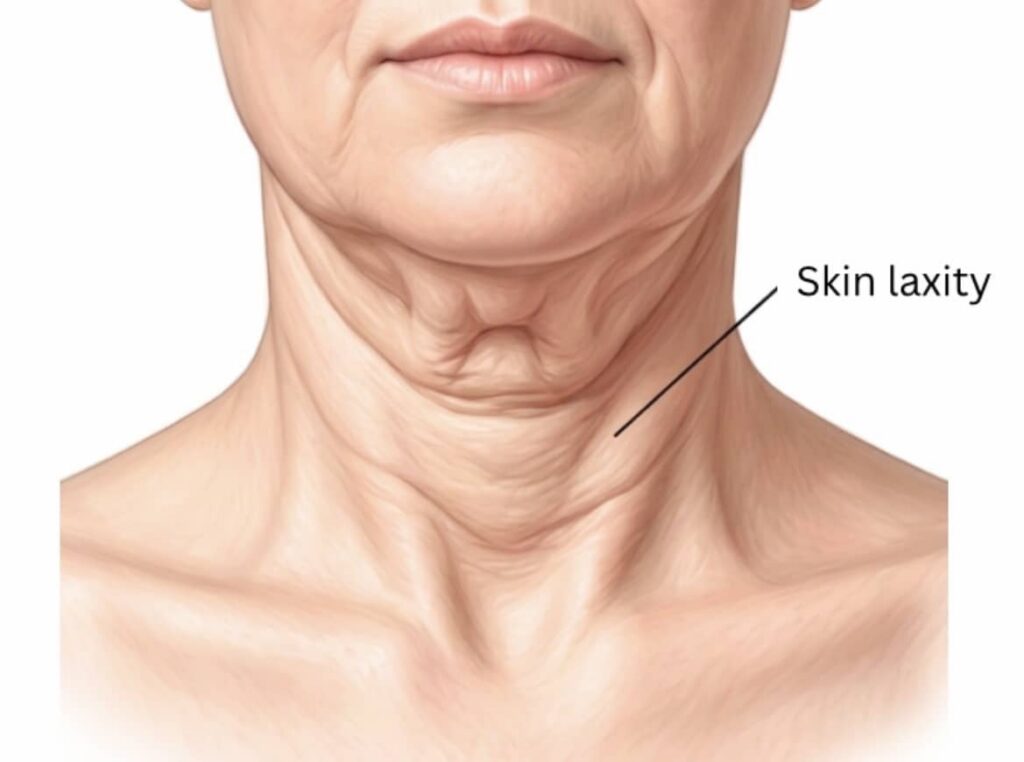
There is no single best treatment for neck wrinkles and sagging neck skin. The most appropriate approach depends on whether the main concern is horizontal neck lines, crepey skin, true skin laxity, or platysmal bands, as these concerns have different underlying causes.
Non-surgical treatments may address skin quality, hydration, texture, collagen support and the appearance of some wrinkles, but they cannot remove significant excess skin or reproduce a surgical lift. A personalised assessment is therefore important to determine what is actually causing the concern and what level of improvement is realistically achievable.
The three most common neck concerns I see
When someone tells me they don’t like the appearance of their neck, I first try to understand exactly what they are seeing.
There are three concerns I see particularly often:
- Horizontal neck lines, sometimes called necklace lines or “tech neck”
- Crepey or sagging neck skin
- Platysmal bands, vertical bands created by the platysma muscle
These concerns can occur independently, but they can also occur together.
The difference matters because treating skin texture won’t necessarily correct muscle bands, and trying to improve genuine excess skin with a treatment designed primarily to improve skin quality is unlikely to produce the result someone may be hoping for.
1. Horizontal neck lines
Horizontal neck lines are static, etched-in lines that run across the front of the neck. They are often referred to as “necklace lines”, or “tech neck”.
Are all horizontal neck lines caused by “tech neck”?
Looking down repeatedly at a phone, laptop or computer can contribute to the formation or worsening of horizontal neck lines. If you spend many hours with your head positioned downwards, the neck repeatedly folds in the same place.
However, not all horizontal neck lines are caused by looking down at a computer or phone.
Genetics, skin structure, sun exposure, skin quality and individual anatomy can all play a role. Some people will develop prominent horizontal lines much earlier than others, even when they don’t have significant skin laxity.
I have seen patients who are relatively young, have good overall skin quality and no obvious signs of general skin laxity, yet have prominent horizontal neck lines.
One patient said she could remember having these lines since her teenage years.
Can horizontal neck wrinkles be completely removed?
This is where I think realistic expectations are particularly important.
Once horizontal lines have been deeply etched into the skin over many years, they will not generally completely disappear.
Depending on the individual and the cause, treatments aimed at improving skin quality may soften the appearance of lines, but complete removal is often unrealistic.
Our goal should not be to make the neck look as though it has never moved or aged. The aim is to improve what is realistically achievable for that person’s skin.
What can help?
Different approaches may be considered depending on the individual, including treatments that support collagen production and skin quality, energy-based approaches and appropriate home skincare.
For example, Rejuran is one treatment where skin quality is part of the concern. Rejuran is a polynucleotide treatment designed to support collagen and elastin production and improve aspects of skin quality, hydration and texture. Suitability and treatment planning are individual. You can read more about Rejuran treatments on our Rejuran page.
Rejuran and other collagen-stimulating approaches are generally not “one treatment and done” treatments. They are often designed as a course of treatments, with improvements developing over time rather than appearing immediately after one session.
Home care is also important.
A simple starting point for many people is to stop treating the neck as though it is a completely separate part of the body and extend appropriate facial skincare down onto the neck.
This may include:
- an antioxidant such as vitamin C
- vitamin A/retinoid products where appropriate
- moisturiser
- daily broad-spectrum sunscreen
However, skincare is individual. Some people can become irritated by vitamin A or vitamin C, and vitamin A products are not appropriate during pregnancy or breastfeeding. The thin skin of the neck can also be more sensitive than facial skin, so products should be introduced appropriately for the individual.
If looking down for long periods is contributing to your lines, simple behavioural changes can also help. Adjust your computer screen so that you aren’t constantly looking down, and be conscious of your head and neck position when using your phone.
2. Crepey and sagging neck skin
“Loose skin” is often used to describe any neck that doesn’t look completely smooth, but there is an important difference between crepey skin texture and genuine skin laxity.
Someone can have crepey skin without having significant laxity.
Crepey skin may be related to changes in the surface and quality of the skin, including sun damage. It can appear thin, with fine a lined and wrinkled texture, even when the underlying skin still has reasonable elasticity.
This is different from someone who has genuine loss of skin elasticity and excess skin.
How do I assess neck skin laxity?
This is something I assess by looking and by touch.
Mild skin laxity can sometimes be visible as thin, loose skin, particularly around the upper neck underneath the jawline. It can become more apparent from a side profile or when someone turns their head.
I also use clinical observation of skin turgor (how the skin returns after it has been gently pinched).
If the skin returns quickly or “snaps back”, this suggests better elasticity. If the skin remains where it was pinched and returns more slowly, or not at all, there may be reduced elasticity and loss of the skin’s ability to recoil.
This is only one part of an overall assessment, but it helps distinguish different types of skin concerns.
Why does this distinction matter?
Because crepey skin and significant excess skin aren’t the same problem.
If the primary concern is skin texture, improving skin quality, hydration and collagen support may be relevant.
If there is significant excess or lax skin, however, non-surgical skin treatments cannot replicate what surgery does.
Non-surgical treatments can support collagen production, hydration, skin texture and the appearance of fine lines. They cannot remove excess skin or surgically reposition tissue.
This is why I think it is important to be honest about what a treatment can realistically achieve.
If someone has significant laxity and is looking for a dramatic lifting effect, I may explain that I don’t believe the treatments available to me will produce the result they are hoping for. Some people are still happy with a more subtle improvement and others decide that the expected difference isn’t enough to make treatment worthwhile.
There is nothing wrong with either decision.
You can learn more about approaches to skin quality and hydration with a Skin Hydration Consultation.
3. Platysmal bands
Platysmal bands are different again.
The platysma is a broad, sheet-like muscle that extends through the neck. When it contracts, vertical bands can become visible.
In younger people, these bands are often not particularly noticeable at rest. They may become visible when the platysma contracts. For example, when making certain facial expressions.
As we get older, platysmal bands can become more prominent and may be visible even when the neck is at rest.
This is important because platysmal bands are a muscle-related concern, not simply loose skin.
Someone may look at their neck and think, “My skin is sagging,” when part of what they are actually seeing is muscle banding.
The appropriate approach therefore depends on what is creating the appearance.
If you are concerned about neck bands or movement-related wrinkles, a Wrinkle Reduction Consultation allows the movement and skin to be assessed rather than assuming that every visible line is caused by lax skin.
Why there isn’t one “best” neck wrinkle treatment.
This is probably the most important thing I would want someone to understand before searching for a treatment.
There isn’t one best treatment for neck ageing.
A person may have:
- deep horizontal neck lines
- crepey skin
- mild skin laxity
- platysmal bands
- sun damage
- changes in the submental area
- or a combination of several of these.
The treatment plan needs to reflect the underlying cause.
For example, if someone has a surface skin-quality concern, the approach may focus on improving the skin itself.
If someone has significant laxity, the conversation is different.
If the concern is primarily muscle-related, that is different again.
And if changes in the chin, jawline or surrounding facial structure are contributing to how the neck looks, the neck shouldn’t necessarily be assessed in isolation. Changes in facial volume and structure can influence the appearance of the lower face and neck. A Volume Loss Consultation can be useful when volume or structural changes are part of the concern.
This is why I prefer an assessment-led approach rather than recommending a particular treatment before seeing someone.
Do neck treatments need to be repeated?
Often, yes.
One of the misconceptions I hear is:
“I had one treatment and didn’t see a difference, so it didn’t work.”
Some collagen-stimulating and skin-quality treatments are designed to be performed as a course rather than a single session. The biological changes also take time.
If a treatment plan involves multiple sessions, completing only the first treatment may not give you a fair indication of the eventual result.
This doesn’t mean everyone needs a particular number of treatments. The appropriate plan depends on the individual, the treatment being considered and the concern being addressed.
But it is important to understand the difference between a treatment designed to create an immediate visible change and one that works gradually by supporting changes within the skin.
Can skincare help with neck wrinkles?
One of the simplest things people can do is also one of the things I see neglected most often:
Take your skincare down to your neck.
Many people concentrate on their face, but stop their skincare at the jawline.
The neck is exposed to the same environment as the face, including ultraviolet radiation, yet it is often overlooked when sunscreen and other skincare products are applied.
As a general starting point, appropriate sunscreen every day is one of the most important habits for protecting the skin from further photo damage.
Other products, such as antioxidants, moisturisers and vitamin A products, may have a role depending on the individual. However, neck skin can be sensitive, so introducing active skincare isn’t necessarily as simple as using everything you use on your face.
What I think people get wrong about treating the neck.
After more than 12 years working in aesthetic medicine, there are three misconceptions I hear repeatedly.
1. One treatment should fix everything
Neck ageing can have multiple causes, so expecting one treatment to address every concern is unrealistic.
Sometimes a combination of approaches is required because there is more than one contributing factor.
2. Non-surgical treatments can produce a surgical result
They can’t.
If you pull loose skin up underneath your jaw and say, “That’s the result I want,” it is important to understand that a non-surgical skin treatment cannot simply reproduce that result.
Non-surgical treatments can improve aspects of skin quality, texture, hydration and collagen support. They do not remove excess skin or surgically reposition tissue.
3. Deep wrinkles should disappear completely
A deeply etched horizontal neck line that has been present for many years may soften with appropriate care, but expecting it to disappear completely is often unrealistic.
We also need to accept that we cannot remain completely wrinkle-free as we age.
Even with excellent skincare and appropriate aesthetic treatments, skin continues to age.
The goal isn’t to look 20 forever. It is to make the most of the skin you have now and maintain it as well as possible over time.
What are the best treatments for neck wrinkles and sagging skin?
The answer depends on which neck concern you have and how significant it is.
Horizontal lines, crepey skin, laxity and platysmal bands are all different concerns, so they shouldn’t automatically be treated in the same way.
My approach is to first assess the neck and identify the contributing factors. From there, appropriate options can be discussed based on your anatomy, skin quality, goals and expectations.
Sometimes, several treatment modalities are appropriate.
And sometimes, if the degree of laxity or excess skin is significant, I will be honest and say that I don’t believe the non-surgical options I can offer will make enough difference to achieve the result someone wants.
I think that is an important part of ethical aesthetic practice.
The best treatment isn’t necessarily the most intensive treatment. It is the treatment, or combination of approaches, that makes sense for the actual cause of your concern and the result you can realistically achieve.
If you are concerned about neck lines, wrinkles, skin texture, laxity or platysmal bands, a personalised Neck Consultation can help determine what is contributing to the appearance of your neck and what options may be appropriate for you.
Frequently Asked Questions
There is no single best treatment for everyone. The appropriate approach depends on whether the main concern is horizontal lines, skin texture, skin laxity, sun damage, platysmal bands or a combination of factors. A personalised assessment is the best way to determine which options may be appropriate.
Deep, static horizontal neck lines that have been etched into the skin for many years generally cannot be expected to disappear completely. Appropriate treatments may soften their appearance, but completely wrinkle-free skin is usually an unrealistic goal.
Horizontal neck lines can be influenced by genetics, repeated neck movement and positioning, sun exposure, skin quality and individual anatomy. Looking down at phones and computers can contribute to their development or worsening, but not every horizontal neck line is caused by “tech neck”.
Crepey skin refers primarily to changes in skin texture and can occur without significant laxity. Sagging or lax skin involves reduced elasticity and, in more significant cases, excess skin. These concerns may require different approaches.
Skin laxity can be assessed by looking at the neck from different angles and gently assessing the skin. Skin turgor, or how quickly the skin returns after being gently pinched, can provide an indication of skin elasticity. A professional assessment can help distinguish laxity from other causes of neck ageing.
Platysmal bands are vertical bands caused by contraction of the platysma muscle in the neck. They can be more apparent during muscle contraction when someone is younger and may become increasingly visible at rest with age.
Repeatedly looking down at phones, computers and other devices can contribute to repeated creasing of the neck and may worsen horizontal lines. However, genetics and other factors also influence neck wrinkles, so not all horizontal lines are caused by technology use.
The number of treatments depends on the concern and the approach being considered. Some collagen-stimulating treatments are designed as a course of multiple sessions and produce gradual changes rather than an immediate result after one treatment. Your recommended treatment plan should be individualised following assessment.
Appropriate skincare may support skin health and help address factors such as dryness, photo damage and skin texture. Daily sunscreen is particularly important. Products containing vitamin A or vitamin C may be appropriate for some people, but neck skin can be sensitive and individual suitability varies.
Non-surgical treatments may improve aspects of skin quality, hydration, texture and collagen support, but they cannot remove significant excess skin or reproduce the tissue repositioning achieved through surgery. Expectations should be realistic when considering non-surgical treatment.
A consultation may be appropriate if you aren’t sure what is causing the appearance of your neck, particularly if you have a combination of lines, crepey skin, laxity or neck bands. The purpose of an assessment is to identify the contributing factors and determine what options, if any, may be appropriate.