Forehead Wrinkles

Forehead wrinkles are horizontal lines that develop across the forehead as a result of repeated facial movement and natural changes in the skin over time. These lines often become more noticeable with age as the skin gradually loses elasticity and structural support.

Several factors contribute to the formation of forehead wrinkles, including muscle movement, changes within the skin, and environmental influences such as sun exposure. Understanding the anatomy of the forehead and how the skin changes over time can help explain why these lines develop.

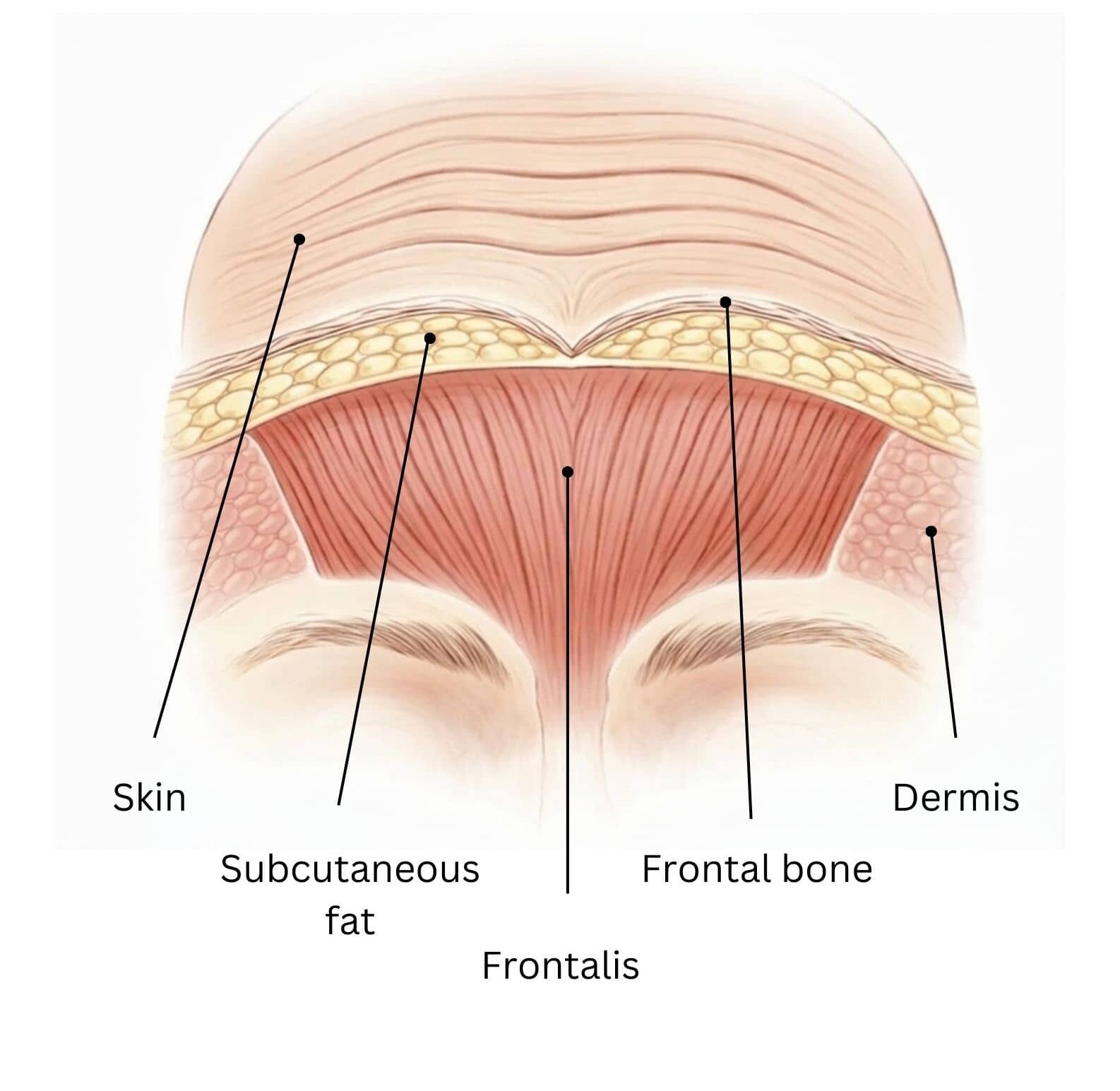
Anatomy diagram of the forehead and frontalis muscle

Why do forehead wrinkles form?

Forehead wrinkles form primarily due to repeated movement of the frontalis muscle, which is responsible for raising the eyebrows and creating facial expression.

Each time the frontalis contracts and raises the eyebrows, the skin across the forehead folds slightly. Over many years, repeated muscle movement combined with changes in skin elasticity can contribute to visible horizontal lines on the forehead.

While muscle movement plays a significant role, several other factors of ageing also influence the development of forehead wrinkles.

The Anatomy of the forehead

The forehead contains several anatomical structures that influence how wrinkles develop over time. These include:

• the frontalis muscle, which raises the eyebrows
• the skin and dermal layers, which provide elasticity and support
• underlying connective tissue and fat pads
• the frontal bone, which provides structural support

Changes in these structures during the ageing process can contribute to visible changes in the appearance of the forehead.


How skin changes may contribute to forehead wrinkles

The skin naturally changes throughout the ageing process. Two important structural proteins within the skin are collagen and elastin, which help maintain the skin's strength and elasticity.

Over time, the production of collagen and elastin production gradually slows. As these proteins decline, the skin becomes thinner and less able to return to its original position after repeated movement, which can contribute to the formation of forehead wrinkles.


Environmental and lifestyle factors

In addition to natural ageing, environmental factors can influence the development of forehead wrinkles. These may include:

• sun exposure
• skin hydration
• genetic factors
• repeated facial expressions
• overall skin health

Because these factors vary between individuals, the appearance of forehead lines can differ significantly from person-to-person.


When do forehead wrinkles usually appear?

Forehead lines can begin to appear at different stages of life. Some individuals notice faint expression lines in their late twenties or thirties, while others may not develop noticeable lines until later.

Early lines that appear only during facial expression are known as dynamic wrinkles. Over time, these lines may become visible even when the face is at rest as the skin gradually loses elasticity, which are known as static wrinkles.

Wrinkles can also appear on other areas of the upper face over time. You can learn more about how ageing contributes to glabellar lines (frown lines) and eye wrinkles .


Understanding forehead ageing during a consultation

During an aesthetic consultation, facial anatomy and skin characteristics are assessed individually.

This may include evaluating:
• muscle movement patterns
• skin quality and elasticity
• facial proportions
• overall facial ageing patterns

A personalised wrinkle reduction consultation allows an assessment of individual anatomy and ageing changes. A consultation provides the opportunity to discuss your individual concerns, and the factors contributing to visible facial changes, and to determine what options may be appropriate for you. Treatment options and results may vary from person-to-person.

Book a consultation

Frequently Asked Questions

Forehead wrinkles form primarily due to repeated movement of the frontalis muscle combined with gradual changes in skin elasticity. Over time, the skin becomes less able to return to its original position after facial expression.

Ageing plays a prominant role in the development of forehead wrinkles. As collagen and elastin decrease in the skin, the skin becomes thinner and expression lines from repeated muscle contraction may become more noticeable over time.

Several factors influence the development of forehead lines, including genetics, skin thickness, sun exposure, facial expression patterns and overall skin quality.

Forehead lines may begin to appear in the late twenties or thirties, although this varies between individuals. Early lines often appear during facial expression before becoming more visible over time.

Environmental factors such as sun exposure and general skin health can influence the appearance of the skin over time. Maintaining good skin care and sun protection can support overall skin quality.